
The gravel and landscaping calculators need JavaScript to run in your browser. Enable JavaScript, or use a browser that supports it, to create an estimate.
Mulch Calculator: Calculate How Much Mulch You Need & Estimate Cost in 2026
Planning a landscaping project, refreshing your flower beds, or covering the soil around your trees? Knowing how much mulch you need before buying can save you money, reduce material waste, and help you achieve an attractive, healthy outdoor space. Our Mulch Calculator makes it easy to estimate the exact amount of mulch required for your project based on the area size, desired depth, and mulch coverage.
Whether you are working on a small garden bed, a large backyard, or an entire landscaping project, this calculator helps you determine the required cubic yards, cubic feet, and number of mulch bags. You can also estimate your material expenses to create a more accurate landscaping budget.
Instead of guessing how many bags or yards to purchase, use a mulch calculator to get a practical estimate before visiting your local garden center or ordering bulk mulch from a landscaping supplier.
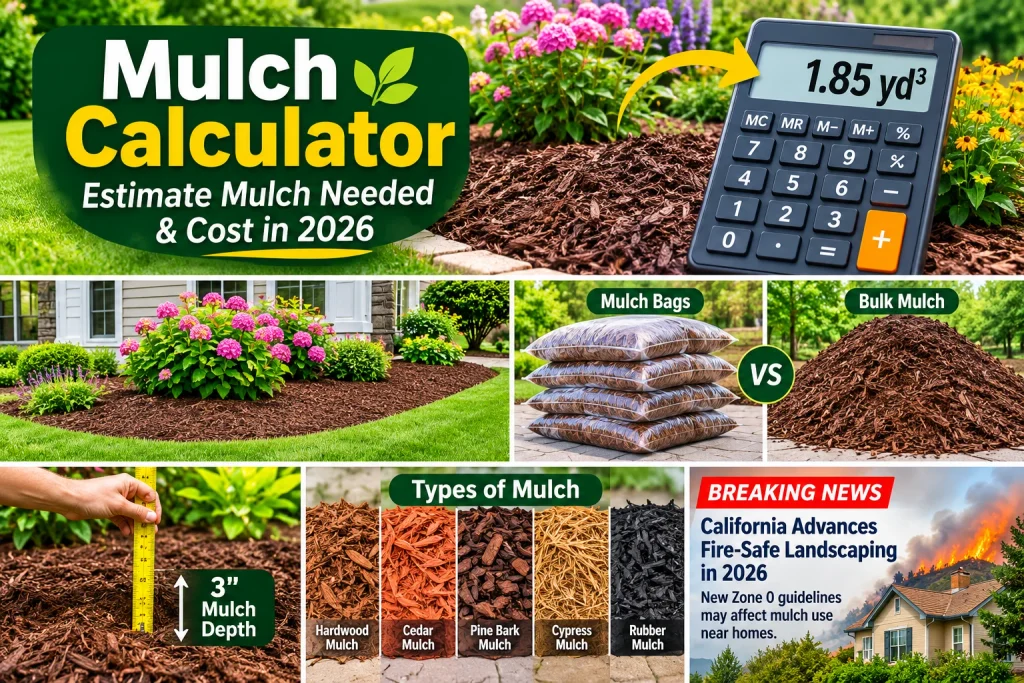
What Is a Mulch Calculator?
A Mulch Calculator is an online landscaping tool that estimates how much mulch you need to cover a specific outdoor area. It uses three important measurements: the length and width of the area and the desired mulch depth.
The Mulch Calculator converts these measurements into cubic feet or cubic yards, helping homeowners, gardeners, and landscaping professionals determine the right amount of material.
For example, if you have a garden bed measuring 20 feet long and 10 feet wide and want to apply 3 inches of mulch, the calculator can estimate the required volume in seconds.
A mulch estimator is especially useful for:
- Residential landscaping and backyard improvements.
- Flower beds and vegetable gardens.
- Tree rings and planting areas.
- Playground and outdoor recreational spaces.
- Commercial landscaping projects.
- Walkways and decorative garden borders.
Using an online mulch coverage calculator also helps you compare bagged and bulk mulch quantities before purchasing.
Table of Contents
How to Calculate How Much Mulch You Need
Calculating mulch requirements is straightforward when you know the dimensions of your landscaping area and the desired application depth.
You can calculate the required quantity using a simple mathematical formula.
Mulch Calculation Formula
Cubic Feet = (Length × Width × Depth) ÷ 12
Measurements:
- Length = Area length in feet.
- Width = Area width in feet.
- Depth = Mulch depth in inches.
- 12 = Inches in one foot.
To convert cubic feet into cubic yards, divide the result by 27.
Cubic Yards = Cubic Feet ÷ 27
These formulas work for rectangular areas. For irregularly shaped garden beds, divide the space into smaller sections, calculate each section separately, and add the results together.
Example: Calculating Mulch for a Garden Bed
Suppose you want to cover a garden bed with the following dimensions:
- Length: 20 feet
- Width: 10 feet
- Mulch depth: 3 inches
First, calculate the total square footage:
20 × 10 = 200 square feet.
Next, calculate the required cubic feet:
(20 × 10 × 3) ÷ 12 = 50 cubic feet.
Finally, convert cubic feet into cubic yards:
50 ÷ 27 = 1.85 cubic yards.
Final Result: You need approximately 1.85 cubic yards of mulch to cover this 200-square-foot garden bed at a depth of 3 inches.
For easier purchasing, you may want to order approximately 2 cubic yards, allowing a small margin for uneven surfaces and minor measurement differences.
How to Use Our Mulch Calculator
Our free mulch calculator simplifies the entire estimation process. You do not need advanced landscaping knowledge or complicated calculations.
Follow these steps for useing Mulch Calculator:
- Enter the area length: Measure the length of your garden bed or landscaping area in feet.
- Enter the area width: Measure the width of the space you want to cover.
- Choose mulch depth: Select your preferred application depth in inches.
- Calculate the quantity: Submit your measurements to estimate the required mulch volume.
- Review your results: Check the estimated cubic feet, cubic yards, and bag quantities if supported by the calculator.
You can use these results to plan your purchase, compare local supplier prices, and avoid buying significantly more or less mulch than your project requires.
How Much Mulch Do You Need Per Square Foot?
The amount of mulch required depends on the surface area and the depth of application. A thicker layer requires more material, while a thinner layer covers a larger area with the same quantity.
Here is a quick reference table showing approximate mulch coverage.
| Mulch Depth | Coverage per 1 Cubic Yard |
|---|---|
| 1 inch | 324 sq. ft. |
| 2 inches | 162 sq. ft. |
| 3 inches | 108 sq. ft. |
| 4 inches | 81 sq. ft. |
| 5 inches | 64.8 sq. ft. |
| 6 inches | 54 sq. ft. |
These figures assume a full cubic yard of mulch and a level application. Actual coverage may vary depending on mulch texture, settling, and surface conditions.
How Much Mulch for 100 Square Feet?
For a 100-square-foot garden bed, the required quantity changes according to the application depth:
- At 1 inch: 0.31 cubic yards.
- At 2 inches: 0.62 cubic yards.
- At 3 inches: 0.93 cubic yards.
- At 4 inches: 1.23 cubic yards.
For most ordinary landscaping projects, a 2- to 3-inch layer is a practical starting point, depending on the mulch material and existing soil conditions.
How Many Bags of Mulch Do You Need?
Mulch is commonly sold in bags measured in cubic feet. Many US home improvement stores offer 2-cubic-foot and 3-cubic-foot bags.
One cubic yard contains 27 cubic feet.
Therefore:
- 1 cubic yard = 13.5 bags of 2 cubic feet.
- 1 cubic yard = 9 bags of 3 cubic feet.
For example, if your project requires 2 cubic yards of mulch:
2 × 27 = 54 cubic feet.
If you purchase 2-cubic-foot bags:
54 ÷ 2 = 27 bags.
You will need approximately 27 bags of mulch to complete the project.
Bagged Mulch vs. Bulk Mulch
Both options have advantages depending on your project size.
Bagged mulch:
- Convenient for small garden beds.
- Easier to transport and store.
- Available in different colors and materials.
- Allows you to purchase smaller quantities.
Bulk mulch:
- Often more economical for larger projects.
- Available by the cubic yard.
- Reduces individual plastic bag waste.
- Can be delivered directly to your property.
Before ordering, compare the total price, delivery fees, and quantity requirements.
How Much Does Mulch Cost in the USA in 2026?
Mulch prices vary across the United States depending on the material, supplier, location, delivery distance, and seasonal demand.
According to a 2026 industry price survey published in October, natural bulk mulch commonly falls around $31–$49 per cubic yard across the middle half of the surveyed suppliers. Dyed mulch is generally around $40–$49 per cubic yard, while cedar mulch can cost considerably more.
Bagged mulch may have a higher equivalent cost per cubic yard.
Here is a general reference:
| Mulch Type | Estimated Bulk Price per Cubic Yard |
|---|---|
| Natural wood mulch | $31–$45 |
| Dyed mulch | $40–$49 |
| Cedar mulch | $47–$80 |
| Pine bark mulch | $43–$55 |
| Cypress mulch | $42–$49 |
| Wood chips | $18–$25 |
These are indicative supplier-price ranges from a 2026 market survey, not guaranteed nationwide retail prices. Delivery, taxes, and installation may increase your final cost.
How to Estimate Your Mulch Cost
You can calculate your material budget using this simple formula:
Total Mulch Cost = Required Cubic Yards × Price per Cubic Yard
For example:
- Required mulch: 3 cubic yards.
- Price per cubic yard: $40.
- Material cost: 3 × $40 = $120.
Your estimated material expense is $120 before delivery, taxes, and labor.
For a more accurate budget, request a quote from local suppliers and check whether delivery charges or minimum order quantities apply.
Breaking Landscaping News: California’s New Focus on Fire-Safe Landscaping in 2026
An important landscaping development in the United States is changing how some homeowners think about traditional mulch and garden materials.
In October 2026, a report highlighted the growing adoption of fire-resistant landscaping in California, particularly around homes located in wildfire-prone areas.
The discussion focuses on Zone 0, the first five feet surrounding a home. Fire-safety recommendations for this area emphasize reducing combustible materials that could ignite from windblown embers.
In August 2026, California’s Board of Forestry approved a proposed statewide Zone 0 regulatory framework for high-risk wildfire areas. However, the rules package was withdrawn in September for clarification, with resubmission expected in November 2026. Therefore, homeowners should not assume that a new statewide requirement is already in force.
This development is particularly relevant to landscaping decisions because traditional wood mulch, bark, and other combustible materials may not be appropriate immediately next to buildings in wildfire-prone locations.
What Does This Mean for Homeowners?
Homeowners planning landscaping improvements should consider local fire-safety guidance before selecting mulch.
Some practical considerations include:
- Check local wildfire regulations and fire department recommendations.
- Consider noncombustible materials, such as gravel or stone, where appropriate near structures.
- Keep combustible mulch away from areas where local guidance recommends a noncombustible buffer.
- Choose suitable organic mulch for garden beds outside restricted areas.
- Review insurance and local property requirements before making major landscaping changes.
This does not mean homeowners need to stop using mulch throughout their gardens. Instead, the important consideration is selecting the right material for the right location.
Source: October 21, 2026, Wall Street Journal report on California’s shift toward fire-resistant landscaping.
Choosing the Right Type of Mulch for Your Landscaping Project
Different mulch materials offer different benefits. Your choice should depend on your landscaping goals, budget, climate, and the type of plants you are growing.
1. Hardwood Mulch
Hardwood mulch is a popular option for residential landscaping. It is commonly used around shrubs, trees, and flower beds.
Benefits include:
- Helps retain soil moisture.
- Reduces weed growth.
- Improves soil organic matter as it decomposes.
- Creates a natural appearance.
2. Cedar Mulch
Cedar mulch is valued for its distinctive appearance and pleasant aroma. It is often selected for decorative landscaping.
Benefits include:
- Attractive natural color.
- Relatively slow decomposition.
- Useful for decorative planting beds.
- Available in different textures.
3. Pine Bark Mulch
Pine bark mulch is commonly used around trees, shrubs, and ornamental plants.
Benefits include:
- Lightweight material.
- Natural decorative appearance.
- Available in nuggets and shredded forms.
- Breaks down gradually.
4. Cypress Mulch
Cypress mulch is used in different landscaping applications because of its appearance and availability in certain regions.
Before purchasing, consider where the material comes from and whether a locally available alternative is more sustainable.
5. Rubber Mulch
Rubber mulch is made from recycled rubber and is commonly used in certain playground and decorative applications.
It does not decompose like organic mulch. However, it does not improve soil organic matter, so it is generally not the first choice for traditional planting beds.
For playgrounds, follow applicable safety standards and manufacturer depth recommendations.
What Is the Best Mulch Depth for Your Garden?
The correct mulch depth depends on the material, soil conditions, and landscaping application.
For many residential planting beds, a 2- to 3-inch layer is a reasonable starting point for coarse organic mulch.
However, applying too much mulch can create problems.
Excessive mulch may:
- Reduce oxygen exchange around plant roots.
- Keep the soil excessively wet.
- Encourage shallow root growth.
- Create moisture-related problems around tree trunks.
When mulching around trees, keep the material away from the trunk and root flare. Avoid creating the familiar volcano-shaped mulch pile.
For existing beds, check the current mulch depth before adding another layer. You may need less material than expected.
Common Mulch Calculation Mistakes to Avoid
Even a simple landscaping project can become expensive when measurements are inaccurate.
Avoid these common mistakes:
1. Measuring the area incorrectly: Always measure the actual planting area rather than estimating its size visually.
2. Choosing excessive mulch depth: More mulch does not automatically mean better plant growth. Follow recommendations for your material and plants.
3. Forgetting to convert cubic feet into cubic yards: Remember that 27 cubic feet equal one cubic yard.
4. Ignoring delivery charges: Bulk mulch may have a lower material price but delivery fees can change the overall budget.
5. Forgetting irregular shapes: Divide circular, curved, or irregular garden beds into smaller measurable sections.
6. Buying without checking existing mulch: If the existing layer is still sufficiently deep, you may not need to replace or add much material.
Frequently Asked Questions About Mulch Calculators
1. How do I calculate how much mulch I need?
Multiply the length by the width of your landscaping area in feet, then multiply by the desired mulch depth in inches. Divide the result by 12 to calculate cubic feet. Divide cubic feet by 27 to get cubic yards.
2. How many cubic yards of mulch do I need for 1,000 square feet?
For 1,000 square feet, you need approximately:
- 3.09 cubic yards at 1 inch deep.
- 6.17 cubic yards at 2 inches deep.
- 9.26 cubic yards at 3 inches deep.
- 12.35 cubic yards at 4 inches deep.
3. How much area does one yard of mulch cover?
One cubic yard of mulch covers approximately 324 square feet at 1 inch deep, 162 square feet at 2 inches, or 108 square feet at 3 inches.
4. How many 2-cubic-foot bags are in a yard of mulch?
There are 13.5 bags of 2-cubic-foot mulch in one cubic yard. In practical purchasing, you will need 14 full bags to obtain at least one cubic yard.
5. Is bulk mulch cheaper than bagged mulch?
Bulk mulch is often more economical for larger landscaping projects. However, delivery fees and minimum order requirements can make bagged mulch a better option for smaller areas.
6. What is the best mulch depth for flower beds?
A 2- to 3-inch layer of coarse organic mulch is a
The 2026 market prices and California fire-safe landscaping development used in the article are supported by these reports:
- 2026 Mulch Prices – Green Industry Report — supplier price research updated October 30, 2026.
- California’s Shift Toward Fire-Resistant Landscaping — October 21, 2026.
- Mulch Delivery and Installation Costs in 2026 — Angi’s October 2026 cost report.